
There are spoilers here. Do yourself a favour and don’t ruin the book for yourself. Read it first.
The case of the murderess Grace Marks had long been forgotten by the public. Fair enough, since the crime took place almost two centuries ago. That is, until Margaret Atwood revived the story and turned it into a harrowing psychological novel steeped in ambiguity. The book falls within historical fiction, occupying that fascinating grey area where fiction steps in to fill the gaps left by history.
Published in 1996, this was far from Atwood’s first rodeo. By then, she had already written The Handmaid’s Tale, and would go on to write The Blind Assassin. Alias Grace is meticulously researched, rich in its depiction of nineteenth-century Canada, and every bit as ambitious as her best work.
But it is also a dark, dark novel. That generous shade of grey which protects the author, allowing space for ambiguity, soon turns into something far more unsettling, a space haunted by the demons of North America’s past.
The novel may be a quick read, but it is not necessarily an easy one. Atwood uses multiple perspectives, epistolary fragments, and textile imagery to construct the world of Alias Grace. It is deception at its finest, if you are willing to be deceived. And mind the gaps. They matter.
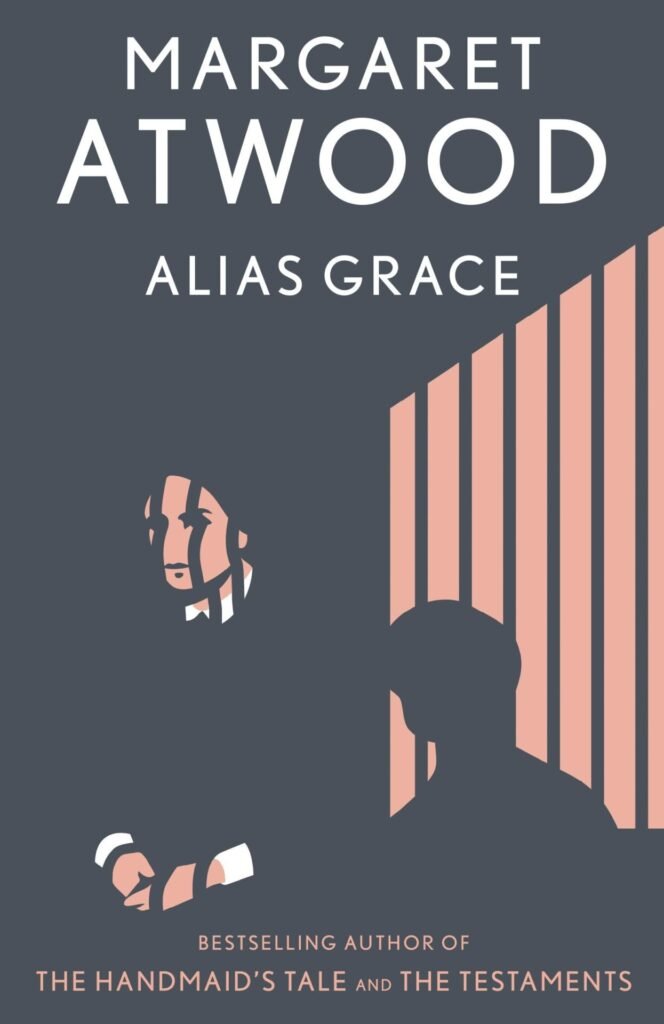
The Mind of a Murderess
Grace Marks was only sixteen when she was arrested alongside James McDermott for the murder of their employer, Thomas Kinnear, and his housekeeper and mistress, Nancy Montgomery. It was a gruesome murder, the kind the media loved. It had all the ingredients: sex, violence, and human fallibility. Nancy Montgomery was found beneath a bathtub, chopped to pieces, while Kinnear had been shot. For this crime, McDermott would hang, and Grace Marks, due to her youth, would serve a life sentence.
When we meet Grace, she is already fifteen years into her imprisonment. Simon Jordan, a doctor interested in mental illness, wants to uncover the truth behind her supposed hysteria. But Grace is defensive, holding back crucial memories. She gradually tells her story, leading us toward the fatal moments of the murder. But she is elusive, forgetful. And who watches the watchmen? Jordan, too, is struggling with his own demons. He is losing touch with his own reality.
Relying on the Unreliable Narrator
There are many unreliable narrators in literature, but Grace Marks might take the cake. We hear her tell the story of her life, recount the events that led to the murder of her employer, and offer her impressions of the visiting Simon Jordan. Atwood keeps Grace’s language simple, but she is far from incapable of noticing everyday beauty. In our minds, as we read Grace’s words and hear her voice, we do not immediately suspect her of malice.
Her voice is plain, straightforward, but we can still detect a faint resentment toward the lot life has given her. Grace, we find, has many reasons to feel embittered: she loses her mother at an early age as the family travels to Canada; her father never truly treats her like a daughter; and she lives a largely solitary life, never really having any friends save one, Mary Whitney, from whom she later takes her alias.
The novel is deceptive, revealing nothing at face value. It is only in the crevices, in the gaps, that we begin to detect inconsistencies in Grace’s words, though these often confuse us more than they guide us. At the time of the murder, the young Jamie Walsh visited the Kinnear property. By then, Grace appeared unbothered, conversing naturally and even wearing her victim’s clothes.
We may be tempted to assume, then, that Grace has been lying, that her performances throughout the novel are an attempt to cover up her own crime and, with it, her own guilt. But our prejudices come into play here. Both readings remain possible. Whether we begin by assuming Grace is guilty or innocent, we are likely, in an act of self-fulfilling prophecy, to find evidence for that assumption between the lines.
We have to entertain the possibility: what happens if we read the novel a second time, but this time assume the opposite?

Carefully Threading the Narrative Quilt
In constructing Alias Grace, Atwood employs various techniques to create the kind of narrative ambiguity that keeps the reader constantly on edge. The perspectives shift between Grace’s first-person account and Jordan’s third-person sections. The effect is curious: the stories run in parallel, the narrative paths cross and tilt, and the power dynamics shift beneath our feet. As Jordan becomes more involved in Grace’s story, he also becomes more infatuated. The hunter, before long, becomes the hunted.
It is the symbolism of the quilt, of fabric itself, that ties these fragments together. Each chapter feels like a patch in a larger quilt, contributing to a cohesive whole. The analogy suits human character well, with each patch standing for a chapter, an experience, a wound, a memory. In the novel, fabric becomes a leitmotif, one Atwood returns to again and again.
The presence of fabric is important in shaping the narrative of the crime, and in some cases, in befuddling it further. Kinnear is found wearing McDermott’s shirt, for reasons that remain unclear. Grace steals Nancy’s belongings when she leaves, and later, once released, has them returned to her. They are among the only things she possesses, aside from her body and mind, when she leaves prison in her mid-forties.
Cloth creates illusion, but it also conceals. Grace’s mind is as ambiguous as the fabric that seems to shield her thoughts. In one fevered dream, Jordan tears through layers and layers of fabric in search of Grace, only to find an outlet for his sexual longing in the arms of his landlady, Mrs Humphrey, beneath that tangled mass. It is one of the most striking images in the novel. Our minds, Atwood seems to suggest, are made of the same material: used to deceive, transform, and shroud our repressed desires.
Atwood constructs the novel much as Grace sews and threads a quilt. She embellishes parts of the story here and there, especially where the facts run out, with symbols that are perhaps obvious only to her. This does not lessen the reader’s enjoyment. Atwood researched the case thoroughly, but as a novelist she still has to choose the details that matter. In that sense, Grace mirrors the process itself:
“So now I am knitting. I am a quick knitter, I can do without looking as long as it is only stockings and nothing fancy. And as I knit, I think: What would I put into my Keepsake Album, if I had one? A bit of fringe, from my mother’s shawl. A ravelling of red wool, from the flower mittens that Mary Whitney made for me. A scrap of silk, from Nancy’s good shawl…”
Grace’s “alias” is another instance in which the symbol of cloth is used to powerful effect. Allegedly suffering from a divided personality, Grace is able to wear different “costumes” depending on the situation. In the shadows of her mind, she takes on the form of Mary Whitney, her friend who took her own life after becoming pregnant. Mary may well be the product of Grace’s repression, manifesting in a darker, more unruly form. Whether Grace resorts to Mary consciously remains open to debate.
The Analogy of the Persian Rug: Weaving the Patterns of Our Lives
Like an elegant black Chanel dress, there is something refined in the way Atwood tailors the fabric of Alias Grace. Beneath the simplicity of Grace’s words lies a corrosive undertone, ready to unsettle the unsuspecting reader. The question of Grace Marks’s guilt will remain contentious. The book presents one possible version of reality, but that is not really the point.
Beyond being a psychological novel, Alias Grace examines class difference, gender roles, and societal norms. Grace Marks, as underdogs often do, sits awkwardly between these forces, and for the novel’s purposes, that awkwardness is precisely what makes her so compelling. She poses troubling questions to each of them. We can ask endlessly who is to blame, whether the cards were marked against Grace because of her poverty, her gender, and her circumstances, or whether this fault is something innate: whether one is born a murderer rather than made into one.
The book partly answers this. In a chilling passage, Jordan seriously considers murdering his landlady, Mrs Humphrey, as she becomes an impediment to his life. While we may question Jordan’s sanity, there is an eerie method to his musings, in how deliberate and calculated each imagined step becomes. The message is clear: anybody is capable of taking another life.
The fabric of our lives, rich with private symbols and meanings, is ours to define. That same fabric makes up our history, our values, our relationships, culminating in the experiences that form a pattern. We are free to weave that pattern as we like. In this sense, there is something close to Maugham’s analogy of the Persian rug in Of Human Bondage:
The fabric of our lives, rich in our own private symbolisms and meanings, are our own to define. This same fabric constitutes our history, values, relationships culminating in experiences which make up the pattern. We are free to weave the patterns as we’d like. In this, there is a similarity to the analogy of the weaving of the Persian rug in Maugham’s Of Human Bondage:
“…as the weaver elaborated his pattern for no end but the pleasure of his aesthetic sense, so might a man live his life [so that] it made a pattern out of the manifold events of his life, his deeds, his feelings, his thoughts [so] he might make a design, regular, elaborate, complicated or beautiful.”
So weave. Weave away. And weave beautifully.