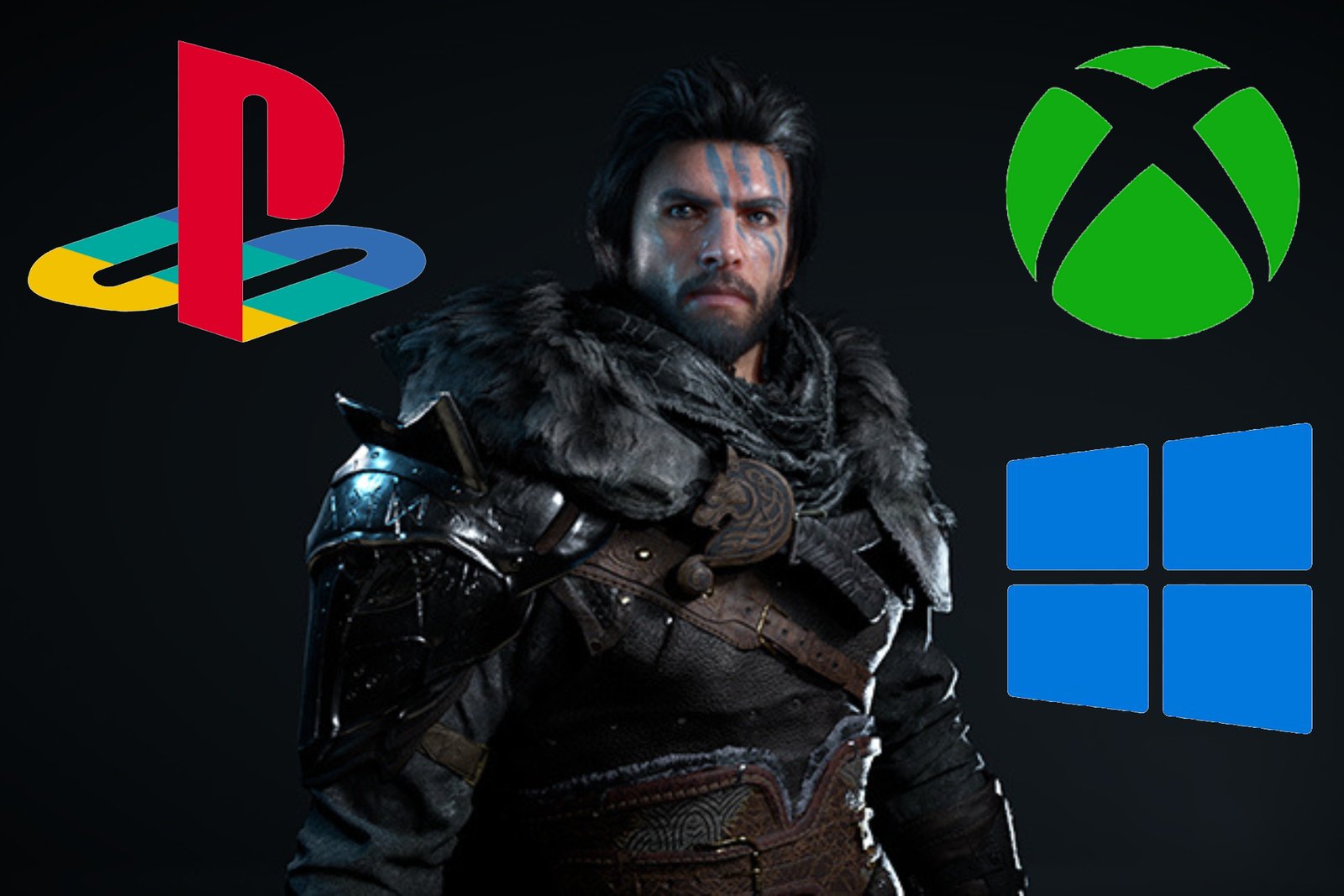
With Crimson Desert, Pearl Abyss is attempting the ultimate industry pivot: trading the endless revenue of an MMO for the prestige of a single-player epic.
On March 19, 2026, the gaming world will finally receive an answer to a question five years in the making: Can a developer synonymous with the infinite grind of MMORPGs deliver a focused, narrative-driven masterpiece?
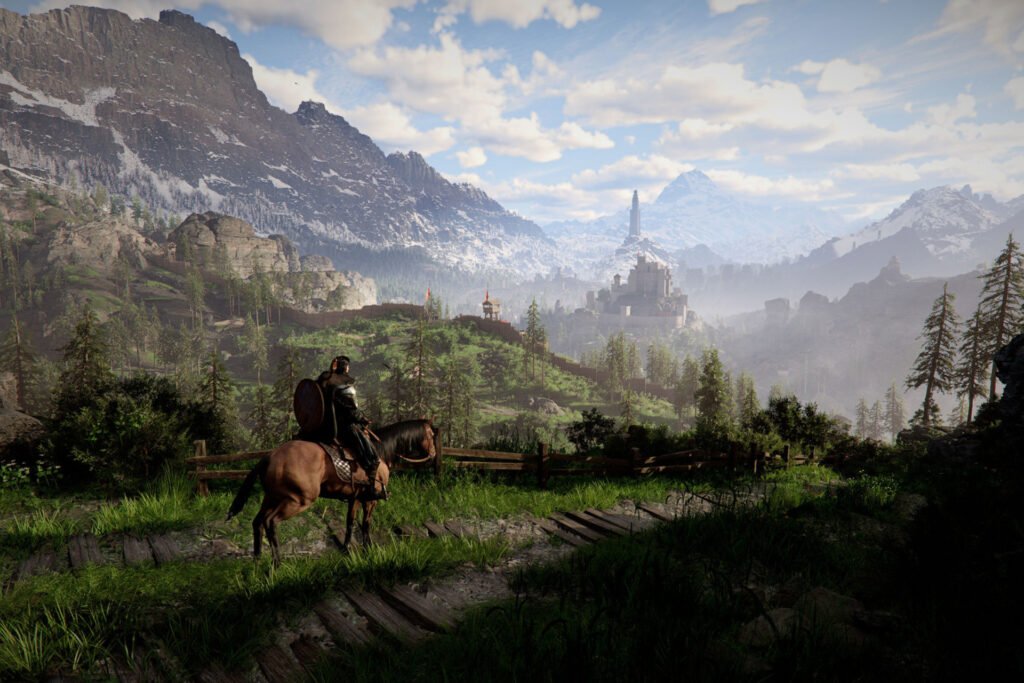
Crimson Desert began its life as a prequel to the massive Black Desert Online, but in a bold and risky move, Pearl Abyss severed those ties. What remains is a sprawling, single-player action-RPG that aims to sit at the same table as The Witcher 3 and Red Dead Redemption 2.
It’s a premium experience in an era of live-service fatigue, but the path to Pywel is paved with staggering technical promises and a last-minute controversy that has PC players sceptical.
The Premium Gamble
In a move that has earned Pearl Abyss significant points, the developer has been remarkably blunt about monetization. Director of Marketing Will Powers recently confirmed that there is no cosmetic cash shop and no microtransactions.
“This is a premium experience. That is the transaction. Full stop.” – Will Powers, Pearl Abyss
In 2026, this is a radical stance for a major AAA release. By pricing the game at a flat $69.99, Pearl Abyss is betting that a complete-at-launch package will generate more long-term brand value than the nickel-and-diming typical of their MMO roots.
While the Deluxe Edition ($79.99) does include bonus items like the Khaled Shield and Kairos Plate Set, the studio insists these aren’t content gates but rather traditional pre-order flourishes.
The Denuvo Elephant in the Room
We have to talk about the “sneak” that happened on March 12. Just one week before launch, the Steam page was updated to reveal the inclusion of Denuvo Anti-Tamper DRM.
For the uninitiated, Denuvo is the boogeyman of PC gaming. While its goal is to prevent Day One piracy, it has a notorious reputation for tanking frame rates and causing CPU stutter due to its constant background verification checks.
Pearl Abyss was quick to go on the offensive, issuing a statement to journalists like Paul Tassi claiming that the impressive Digital Foundry benchmarks and official trailers were recorded with the exact same implementation of Denuvo found in the launch build.
A Platform-by-Platform Reality Check
While most of the industry has flocked to Unreal Engine 5, Pearl Abyss is doubling down on their in-house BlackSpace Engine. It’s a powerhouse, but it demands respect (and hardware).
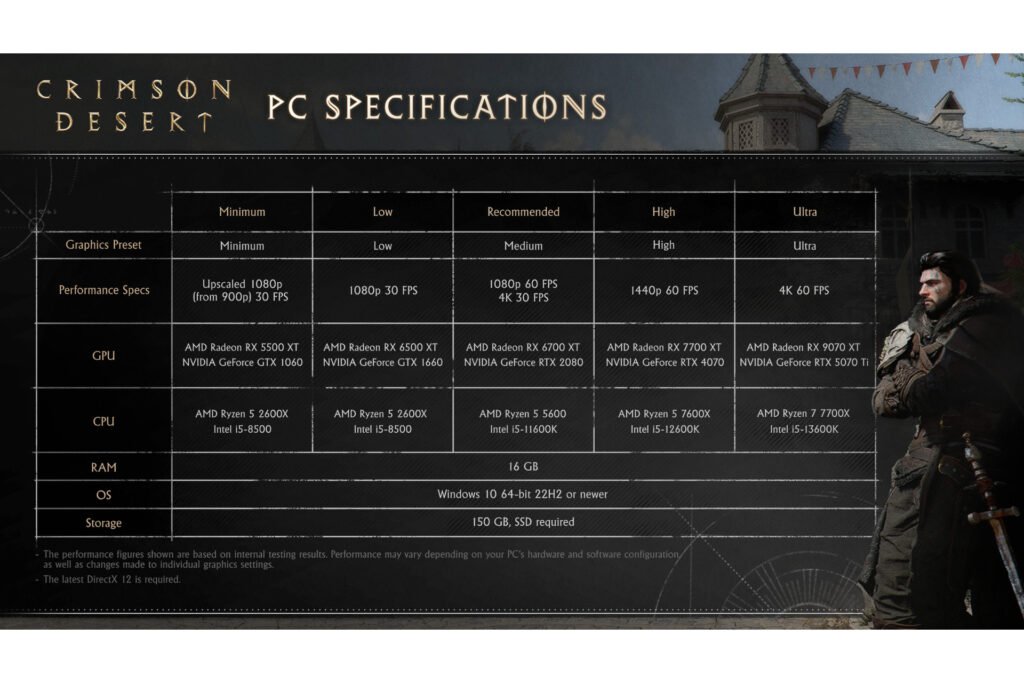
PC
| Target | CPU | GPU | RAM |
|---|---|---|---|
| Min (1080p/30fps) | Ryzen 5 2600X / i5-8500 | GTX 1060 / RX 6500 XT | 16GB |
| High (1440p/60fps) | Ryzen 5 7600X / i5-12600K | RTX 4070 / RX 7700 XT | 16GB |
| Ultra (4K/60fps) | Ryzen 7 7700X / i5-13600K | RTX 5070 Ti / RX 9070 XT | 16GB |
- Note: An SSD with 150GB of space is mandatory. PC players should also be aware that Denuvo requires an internet connection for periodic license checks.
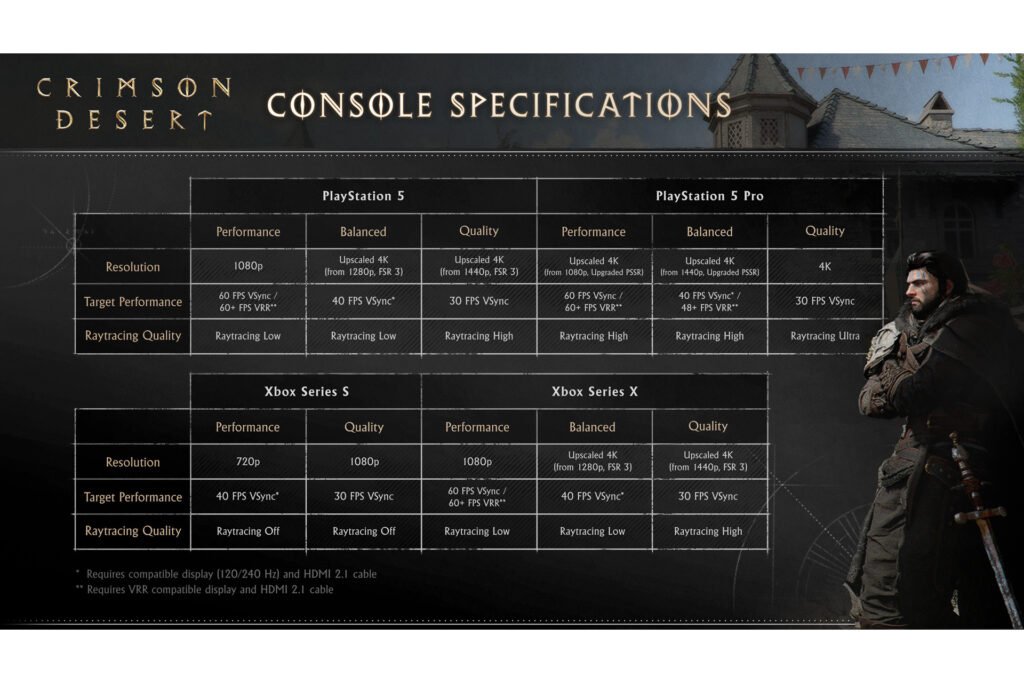
PlayStation 5 Pro
If you own a PS5 Pro, you’re getting the prestige console experience. Pearl Abyss is utilizing the new PSSR 2 (PlayStation Spectral Super Resolution) to punch far above standard console weight.
- Performance Mode: Upscaled 4K (from 1080p) at a target 60fps. Includes High-quality Ray Tracing.
- Balanced Mode: Upscaled 4K (from 1440p) at 40fps (requires 120Hz display).
- Quality Mode: Native 4K at 30fps with Ultra Ray Tracing—the only mode to offer the highest lighting fidelity on consoles.
PlayStation 5 & Xbox Series X
The base consoles are neck-and-neck, offering a solid experience that relies on FSR 3 for upscaling rather than Sony’s proprietary PSSR.
- Performance Mode: 1080p at 60fps. Ray Tracing is enabled but set to “Low.”
- Balanced Mode: Upscaled 4K (from 1280p) at 40fps.
- Quality Mode: Upscaled 4K (from 1440p) at 30fps with High-quality Ray Tracing.
Xbox Series S
- Performance Mode: 720p at 40fps (120Hz display required).
- Quality Mode: 1080p at 30fps.
Nintendo Switch 2
The newly confirmed Nintendo Switch 2 version is targeting a late 2026 window, likely relying heavily on DLSS to manage the BlackSpace engine’s heavy physics load.
High Stakes in Pywel
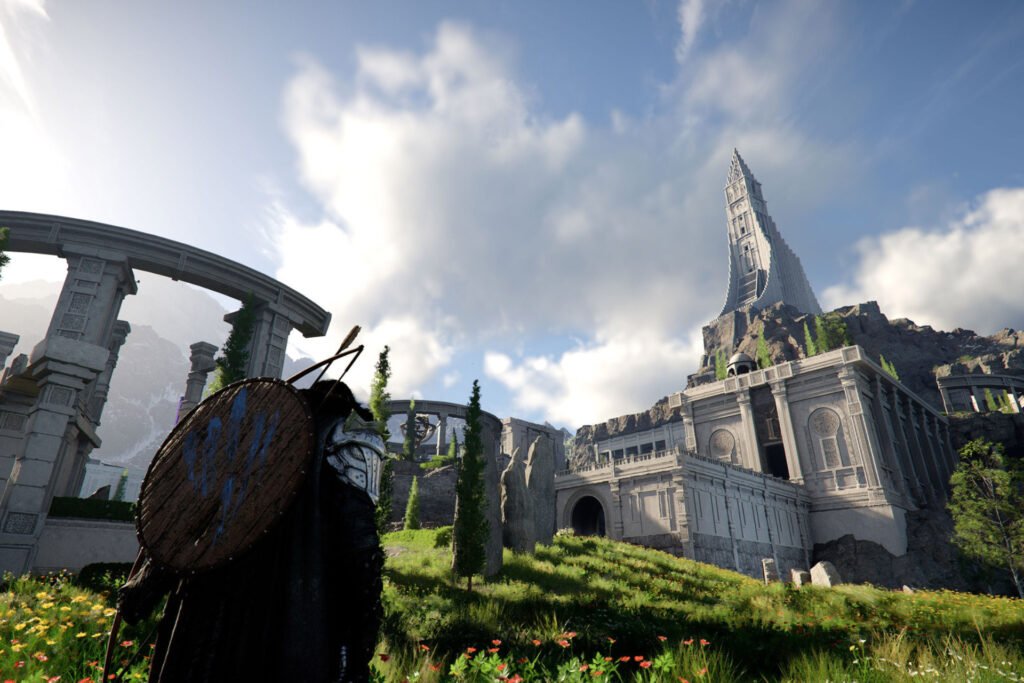
Crimson Desert is a litmus test for the South Korean development scene. If it succeeds, it proves that premium still sells and that proprietary tech can still outshine the Unreal monoculture.
Despite the Denuvo controversy, the transparency from Pearl Abyss, like sending codes to technical analysts weeks in advance, is a sign of a developer that knows they have a winner.
Pywel opens its gates on March 19. Whether you’re chasing 4K/60 on a 50-series card or just hoping to survive the hordes on a Series S, one thing is clear: the bar for open-world RPGs is about to be moved.