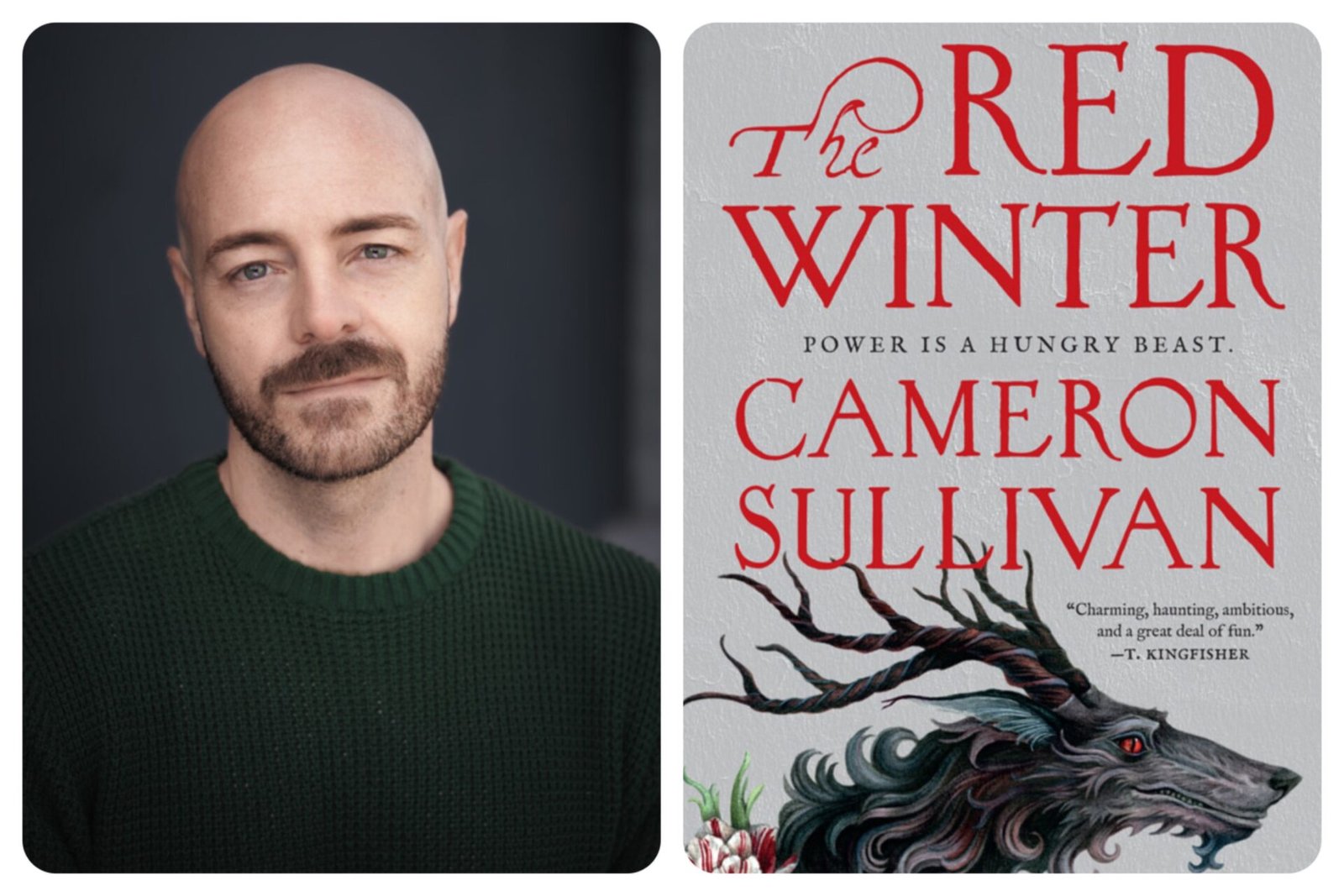
Cameron Sullivan’s historical fantasy novel The Red Winter, published by Tor Books, has quickly drawn attention for its blend of folklore, horror, and real historical events surrounding the legend of the Beast of Gévaudan. The book debuted this week as an instant New York Times, USA Today, and Indie bestseller.
Beyond its historical setting, the novel stands out for the careful research and structural craft behind it, weaving together multiple timelines, historical sources, and moments of dark humor.
I spoke with Sullivan about the origins of the book, the challenge of researching eighteenth-century France, the process of structuring a multi-timeline narrative, and how humor can coexist with horror in historical fantasy.
What was the very first seed of The Red Winter? Was it the story of the Beast of Gévaudan, a book or a trip to France that grew into the novel?
The story of the Beast was definitely the first spark. I can’t think of another genuine historical monster hunt that’s so well documented. I remember reading about it and being fascinated by how much superstition and folklore had already crept into the history. The sources really show how it captured the imagination of the whole country. There are the grand official documents from the king and the authorities, newspaper articles and church death records. Then there are some very personal eyewitness accounts and letters. The confusion about the Beast’s identity is clear in the woodcuts and illustrations. You can feel the fear and despair in messages sent by the king’s hunters when they can’t find a way to kill it. It already had all the ingredients for a horror story, so it didn’t take much for me to build it from there.
As a French reader, what struck me is that the cultural and historical details feel unusually authentic. How did you avoid writing “generic France” ? What details mattered most to make the setting feel real?
It makes me very happy to hear that! I think guesswork is the enemy of authenticity for anything set in the real world, so I went deep into the research whenever I was unsure. Having Sebastian as a narrator also helped, because he’s something of an outsider wherever he goes; everything is of interest to him and he’s happy to share his insights with the reader.
The details that mattered most were the small, everyday things, which were also the most difficult to research. There is a lot of information about the broader historical context and the affairs of the rich and powerful, but people rarely record the small details. It’s not so easy to find an account of how horses were cared for on the road, how clothing was washed, or how regular people sourced and prepared their food, for example. These small things have huge implications for broader society, particularly in the context of pre-Revolutionary France, where they tie into issues like family, travel, poverty and power.
How did you approach research for French History? Did you rely on academic sources, primary documents, fiction or visual material?
All of the above. The primary documents were fascinating, though I had to read English translations of most of them (I’m ashamed to admit I don’t speak French). One of the most fascinating things about this particular history is that you can see it change into folklore over time as it gets reassessed and absorbed into fiction and then popular culture. The secondary sources can be quite speculative and I found them very helpful in setting boundaries on what I could get away with in the story – present-day historians provide a lot of ‘big picture’ context that the primary sources can’t. I also used some of the fiction from the time for authenticity. Les Liaisons Dangereuses (1782) was a great insight not only into the politics of gender and influence at the time, but also of the preoccupations of the upper class and how they saw themselves.
You blend different myths into a story that converges in Gévaudan, different timelines with recurring characters. Was there a point where you gave yourself permission to blend things together?
I kept coming across references to Joan of Arc during my research, so I delved a little deeper into her story and made some vague plans to write a whole separate ‘case file’ for Sebastian on her story and her connection to Gilles de Rais. It didn’t occur to me to blend everything together into one story until I was reading about Napoleon and his use of Roman symbolism. I was struck immediately with the idea of connecting all those centuries of history with the common thread of Ancient Rome.
What did your outlining process look like? Did you plot heavily in advance or did the book evolve organically as the romance unfolded?
I was writing it mostly as a labor of love, so it was very loosely plotted to begin with – I just enjoyed joining Sebastian and Sarmodel on their dangerous journey. I had no idea about the ending or the major reveals. It was only when I had about half of each timeline completed that I realized I needed to do some planning. I printed out a summary of each chapter on little notes and started to put it all in order. I ended up with a bunch of notes pinned to a corkboard in my living room like a conspiracy nut, but it was very helpful.
The novel has a lot of humor, including puns and jokes that feel “hidden in plain sight”. Was that intentional from the start, or did the humor emerge naturally as you found the characters’ voice?
The humor was intentional and I found it the hardest thing to write; it’s very exposing to show the world what you think is funny! At the same time, it became such an integral part of the characters that it grew more natural as I went along. A lot of them are objectively dreadful and I thought it was important to be able to laugh both with them and at them.
How do you write comedy without breaking the historical atmosphere? Do you have rules, or do you let humor act as a pressure valve?
There weren’t rules, exactly, but there were plenty of wisecracks that didn’t make the final version – I think Antoine had some sexy banter with Sebastian while they were standing over a corpse at one point, which didn’t feel right. It was definitely a pressure valve as well. I found the comedy helped to balance the darkness of the story and hopefully steered the more emotional moments away from melodrama; we are all quite ridiculous when we’re in love and I wanted to include that as part of what Sebastian remembered.
What was the hardest part of writing the book from a technical craft standpoint? A specific scene, pacing the tension, exposition, or character arcs?
Weaving together the multiple timelines was definitely the hardest part. It was so difficult, having written the whole story, to figure out who knew what and when so that the whole thing made sense. Thankfully, my agent Christabel McKinley and my editor at Tor US, Ali Fisher, helped me get it in order – it would be far less coherent without their input!
Can you talk about revision? What changed the most between the first draft and the final version? What kind of feedback shaped the book in the biggest way?
It’s hard to choose – I had so much incredible, insightful feedback during the revision process. The thing that changed the most was the ending, I think. I originally had a much more complicated ending that required a whole chapter of ‘catch-up’ that ruined what should have been a very tense moment. There were lots of others, but I think the most impactful feedback was from my agent, Christabel, who helped me ensure Sebastian and Sarmodel were never too monstrous or too crass.
If you could give one piece of advice to writers attempting historical fantasy, what would it be? Especially when writing about a country that isn’t your own.
Never trust your first impression, particularly if you’re writing about a period that’s been covered a lot already. There are layers and layers of folklore and pop culture in how we perceive Ancient Rome, for example, that immediately conjure up a population of people in togas walking through white marble colonnades. Rarely is any of this accurate. Genuine, professional historians and primary sources are where you’ll find the most accurate details – and often the best story beats.
Now that The Red Winter is going out, what’s next for you? Do you see yourself returning to Sebastian Grave and Livia in a sequel, or are you already exploring a different project? And if you can share anything at all: what kind of setting, genre, or atmosphere are you drawn to next?
I’m already off on my next adventure with Sebastian, Sarmodel and Livia! It’s not a direct sequel, but it’s another dark mystery they have to unravel and they’ll all be making terrible decisions and falling in love with the wrong people. Without giving too much away, I’m doing a lot of research on European witch-hunts in the 1500s…
For more information about Cameron Sullivan and his upcoming projects, visit his official website:
https://www.cameronsullivanbooks.com