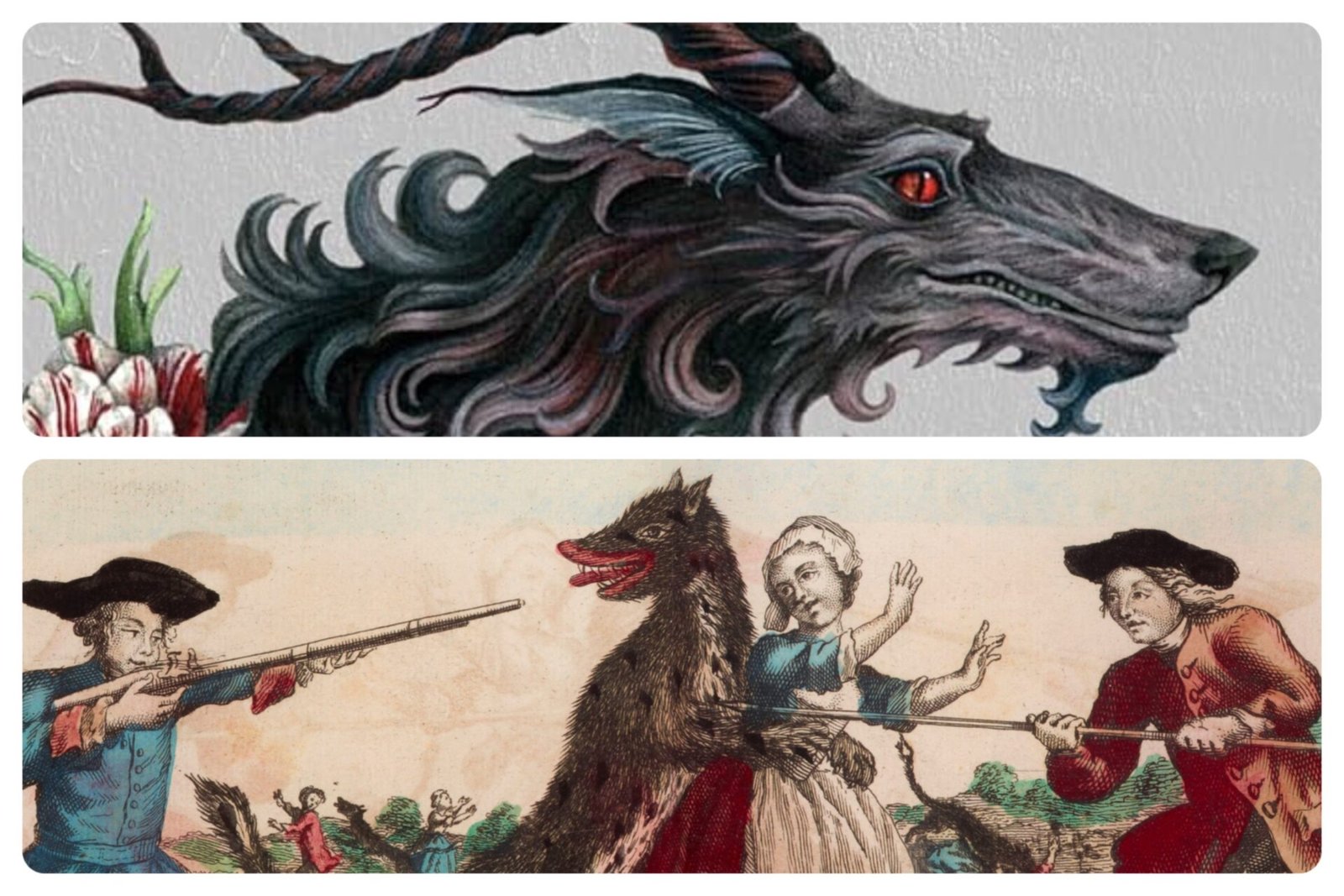
Between 1764 and 1767, a creature known as the Beast of Gévaudan terrorized rural France, killing dozens and fueling panic across the countryside. Historians still debate what it was. Folklore never stopped insisting it was something worse. In The Red Winter, Cameron Sullivan reimagines that legend through three interwoven timelines, blending historical realism with mythological invention, queer romance, and visceral, blood-soaked fantasy. The result is both brutal and intimate, and a sinful delight at every page.
A Return to Gévaudan
The story opens in 1785. Sebastian Grave is summoned back to Gévaudan as whispers spread that the Red Winter has begun again. The land, once more, fears the return of the Beast. But despite having the face a terrifying monster once more, Sebastian is mostly preoccupied with meeting an old acquaintance, Antoine.
From this point, the novel moves across three different timelines, each giving out context around the hunt for the beast, and its origin, until everything converges into the reveal.
History Done Right
At every turn, the book impressed me with its historical precision. As a French reader, I was initially anxious that the novel might be too loose with certain details, enough to pull me out of the story. On the contrary, it genuinely impressed me. Not only are the historical facts accurate and masterfully intertwined with the fantasy elements, but the atmosphere of eighteenth-century Gévaudan feels remarkably authentic.
From the descriptions to the names, down to smaller details such as food, manners, and social dynamics, everything carries a sense of legitimacy. Sullivan even retains a light touch of French vocabulary to deepen immersion without overwhelming the reader. French history is handled with confidence, weaving together multiple historical episodes to flesh out the Beast’s origin and identity.
The Myth Behind the Monster
Yet The Red Winter does not treat the Beast as a mere historical curiosity. The novel leans fully into its mythological dimension, reimagining the creature not simply as predator, but as symbol, inheritance, and force beyond rational explanation. The cast expands accordingly. A mischievous succubus with razor-sharp wit. A sharp-tongued demon. A melancholic angel. Individuals possessed by ancient entities. Even a witch whose presence deepens the folkloric atmosphere.
Despite this ambitious range, none of these figures feel out of place. Each new character enlarges the mythology in coherent ways, enriching rather than cluttering the narrative.
Because The Red Winter isn’t just a monster hunt. It’s also a mythological account of the monster’s origin and fate. And because the book is extra ambitious, we also have a beautiful and passionate queer romance that tightens the narrative and gives extra tension.
A Queer Romance Under Threat
It seems to me that this romance is the perfect ingredient for the book’s formula. Because it’s passionate, we fear that one of them would die. Because it’s queer, we fear that they might be discovered, in an era in which such relationships are frowned upon. Because it’s past, we wonder what happened and if the passion is still alive.
This results in a narrative unafraid of sentiment. The emotional scenes are handled with confidence, never tipping into excess. The novel knows when to be tender, when to be explicit, and perhaps most importantly, when to stop. That restraint leaves the reader with precisely the right amount of longing.
Tone and Theme
Another distinctive feature of The Red Winter is its humor. There’s a lot of it, and some of which is hidden in plain sight. Whether it’s a deadpan joke or a very clever choice for a city, the book never fails to relieve tension at the proper moment. But humor, as good as it gets, never gets in the way of tension, narration and drama, which is a strong feat.
Beyond its layered structure and mythology, The Red Winter interrogates the nature of violence, how it circulates, how it contaminates us into doing horrible things or rather liberating acts of defense. The Beast has more to it than a blood thirsty monster. Its ties got way back, and justify a number of violent episodes in France and other places.
The three-timeline structure can occasionally feel disorienting before its connections become clear, particularly in the strand that does not feature the main cast. Yet the eventual convergence rewards the reader’s patience.
Conclusion
If 2026 continues at this level, it will be a strong year for historical fantasy. The Red Winter sets the bar early. It is ambitious without losing intimacy, mythic without abandoning history, and romantic without sacrificing brutality. And personally, I think I could have stayed with Sebastian Grave for a whole trilogy without a sweat.
Readers who enjoy historical fantasy grounded in real events will find much to admire here. Fans of romance with genuine emotional stakes will be equally rewarded. And those drawn to dark, myth-infused narratives in the tradition of folkloric horror will find The Red Winter particularly satisfying.