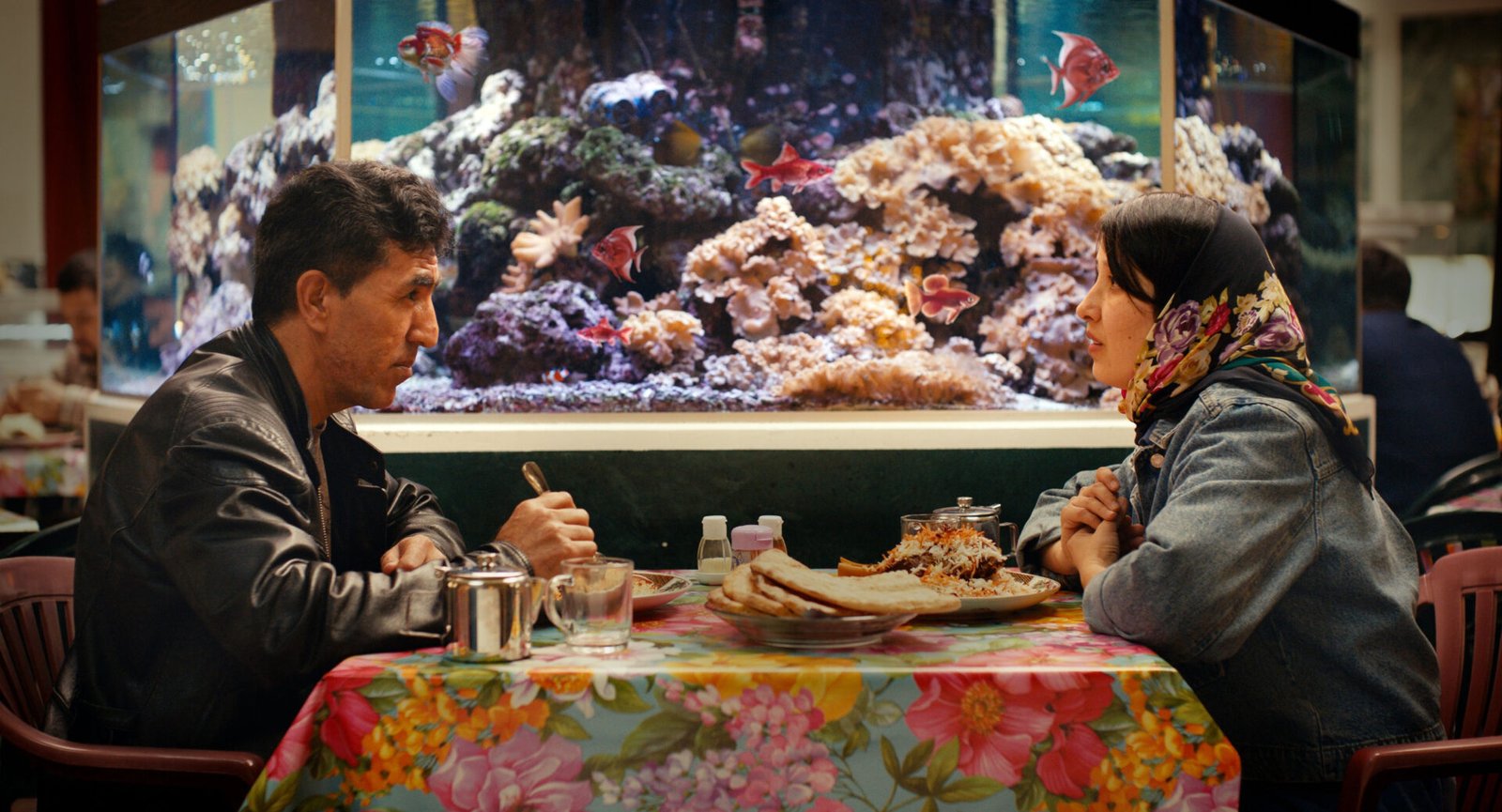
It is always a challenge to land the opening slot at a prestigious festival such as the Berlin International Film Festival but this year’s opener, Shahrbanoo Sadat’s No Good Men, measures up to the standard. This romantic drama taking place in Kabul on the eve of the Taliban’s return to power in 2021 borrows elements from Sadat’s and her friends’ lives, effectively creating a realistic and poignant picture of what life for young women in Kabul looked like at the time.
Triple threat Sadat directs, writes, and stars in the lead role of Naru, the only camerawoman at a Kabul TV station, who is struggling to keep custody of her three year old son after separating – but not yet officially divorcing – from her cheating husband. When one of the cameramen for the station’s news segment gets indisposed, she has to jump into his role. The station’s leading journalist Qodrat (Anwar Hashimi) is hesitant to work with a female camera operator at first, assigning her a mindless Valentine’s Day feature after a slip of her headscarf gets their interview with the Taliban cut short, but Naru rises to the occasion and delivers a feature none of her male coworkers could. Qodrat recognizes her talent and decides to start bringing her along to the field assignments as the two cover the city’s last days of freedom.
From the opening credits, a montage of colourful flowers set to upbeat music, it is clear that Sadat has a strong grasp on leveraging contrasting visuals to drive the story home. In one of the early scenes, Naru is working behind the camera of a talk show for female audiences when a 25 year old mother of six and a victim of domestic violence calls in to ask for advice. Her story is grim, but as the male host tells her that it’s her fault because women are like flowers and lose their petals with age, he is surrounded by a pink, colourful set design. When Naru interviews women for the Valentine’s Day segment, the older women talk about their husbands beating them with a smile on their faces.
Their circumstances are deeply tragic but the colour and the smiles tell the audience that these women’s stories are not something that can be challenged in their society but rather needs to be accepted and coped with in any way one can. This is exactly why Naru’s behaviour seems so radical. She works a job that is traditionally male and doesn’t hesitate to challenge the norms. When she and Qodrat go to a restaurant for lunch between assignments, she refuses to sit in the family area and chooses to sit by the aquarium in the main dining space. She is the only woman there and as the men from other tables give her looks that will make audiences uncomfortable even through the screen, Qodrat expresses his surprise at her willingness to sit there, claiming that women usually prefer to sit in the family area. Naru disputes that notion. No one likes to eat their meals in a dark, hidden room. It is just that women are expected to sit there.
She challenges the norms throughout the film’s runtime, one way or the other, even going as far as requesting her bag to be searched at a security checkpoint when the staff skip over her because she is a woman and, therefore, not seen as a threat. This particular detail comes full circle later in the film when a tragedy strikes at the wedding of the TV station’s director. It’s one of many examples of just how meticulously crafted this film is. Sadat ties all the bows very nicely and it is satisfying to watch as things click into place the closer to the end we get.
The ending itself is predictable and somewhat formulaic. The film ends on a romantic note that is arguably less effective than a platonic one would be as it implies that in order to gain a man’s respect, a woman needs to serve a physical purpose in his life which contradicts a lot of what Naru spends the entire runtime fighting against but also works well as Sadat and Hashimi give solid performances with undeniable chemistry. Simultaneously, though, the ending is efficient in how it highlights the broken law and social norms that trap and leave so many women behind which is ultimately what the film sets out to do.
No Good Men is structurally by the book. There is nothing too out of the box about it that would be reminiscent of Berlinale’s previous opening film, Tom Tykwer’s The Light, but it’s also clear that Sadat has read and carefully studied the aforementioned hypothetical book. It’s a film that uses all the right, expected cues and details but there is no denying it subverts the expectations of the context in which it takes place and delivers a heartbreaking portrait of a society that made making this film a risk.
No Good Men: Shahrbanoo Sadat strikes a near perfect balance of structurally safe yet thematically courageous storytelling to highlight a broken law and social norms that trap and leave women behind. – Pia Ocvirk